Isaiah 53
1 Who has believed our message
and to whom has the arm of the LORD been revealed?
2 He grew up before Him like a tender shoot,
and like a root out of dry ground.
He had no beauty or majesty to attract us to him,
nothing in His appearance that we should desire Him.
3 He was despised and rejected by men,
a man of sorrows, and familiar with suffering.
Like one from whom men hide their faces
He was despised, and we esteemed him not.
4 Surely He has borne our griefs
and carried our sorrows,
yet we considered him stricken by God,
smitten by Him, and afflicted.
5 But He was pierced for our transgressions,
He was bruised for our iniquities;
the punishment that brought us peace was upon Him,
and by His stripes we are healed.
6 We all, like sheep, have gone astray,
each of us has turned to his own way;
and the LORD has laid on Him
the iniquity of us all.
7 He was oppressed and afflicted,
yet He did not open His mouth;
He was led like a lamb to the slaughter,
and as a sheep before its shearers is silent,
so He did not open His mouth.
8 He was taken from prison and from judgment,
And who will declare His generation?
For He was cut off from the land of the living;
For the transgressions of My people He was stricken.
9 He was assigned a grave with the wicked,
and with the rich in His death,
though He had done no violence,
nor was any deceit in His mouth.
10 Yet it was the LORD's will to crush him and cause him to suffer,
and though the LORD makes His soul an offering for sin,
He will see his offspring and prolong his days,
and the will of the LORD will prosper in His hand.
11 After the suffering of His soul,
He will see the light of life and be satisfied;
by His knowledge my righteous servant will justify many,
and He will bear their iniquities.
12 Therefore I will give Him a portion among the great,
and He will divide the spoils with the strong,
because He poured out his life unto death,
and was numbered with the transgressors.
For he bore the sin of many,
and made intercession for the transgressors.
Isaiah 53 was written many centuries before Jesus was born, and yet, it tells of His death on the cross for our sins. And He willingly did it, so great was His love for us. So desirous of us to have eternal life with Him that He shed His blood, took the sins of the entire world, past, present and future, of ALL mankind, for all the sinners, us as well as the murderers, the liars, the cheaters, the adulterers, the thieves, and on and on. While we may view sin on a "sliding scale", God doesn't. We ALL are sinners. The only person who was ever perfect and able to be that sacrifice on our behalf was the Son of God, who left His realm of glory in heaven and humbled himself to become like us, as a son of man, in order to fulfill the Covenant that God made with Abraham so many years ago.
In this post will explain the Abrahamic Covenant and what it means for us and why Jesus was the fulfillment of that Covenant, who He was and, most importantly, why He had to die.
This information comes from my friend Jack Kinsella and the Omega Letter. (His powerful explanation is just one reason why he is missed so much)
Why Did Jesus Have To Die and What's so "GOOD" About Good Friday?
Yesterday as we were coming home from church, my grandson Bailey chirped, "Gwandad!! Jesus died for you!" There was a pause and he said, "He died on a Cross because bad men put him there. He was covered with boo-boos!" (Being three, Bailey is not up on all the latest medical terms, but he knew what he was talking about) "An' He died for Mummy and for Gwandma and because He loves us."
I was absorbing all this as I drove when Bailey asked me the next logical question. "Gwanddad!" "Yes, Bailey." "Why did He have to die?"
When we got home, I tried to explain to a three-year old something that many adult Christians have difficulty explaining. Yet it is one of the first questions posed by the skeptic.
Why, indeed, if Jesus was God, did He have to die? To the skeptic, the whole Cross, Blood and death thing doesn't make any sense. I know many Christians to whom the answer is simply, "So He could be resurrected on the third day."
That was never a satisfactory answer when I was a skeptic, either.
According to Christian tradition, the Friday before Easter is called "Good Friday" because it is the day that Jesus Christ was crucified. GOOD Friday?
The Crucifixion most probably did not actually take place on a Friday, anyway. The Scriptures make reference only to the 'Sabbath' and there were two Sabbath days during that particular Passover week.
But it is on Friday that the world remembers, whether it wants to or not, that a Man was crucified on a hill called Golgotha outside the walls of Jerusalem for the sins of mankind.
If the world wants to remember it as a Friday, at least it is taking note of the event. Arguing about whether or not it actually took place on Wednesday or Thursday seems irrelevant to the central point.
Particularly in light of the way it remembers that day, as "Good" Friday. But what is so good about it?
I can recall as a kid growing up in a Catholic school thinking it more than a little strange that all those nuns said they loved Jesus, but celebrated the day of His execution as a "Good" day.
Indeed, as a kid, I thought the designation "Good Friday" was evidence that they really didn't LIKE Him very much, despite their protestations of love. My mother had passed away when I was only ten. I didn't think that the day that she died was a 'good' day for me.
There are lots of possible reasons why the day of Jesus' Crucifixion is designated "Good" in English. One is that the word 'good' was derived from the word "God".
Our word 'goodbye' came from the phrase "God be with you," so, according to that line of thinking, "Good Friday" would have originated from the phrase "God's Friday."
But I think it is less a case of the metamorphosis of language than it is an apt description of the Event that took place on that day just before the Passover two thousand years ago.
The execution of Jesus Christ was an event of incredible evil. He was guilty of no infraction, violated no laws, either Mosaic or Roman civil, and His betrayal was orchestrated, the Bible says, by Satan himself.
"And after the sop Satan entered into him [Judas]. Then said Jesus unto him, That thou doest, do quickly." (John 13:27)
But while the crucifixion of Jesus Christ was an act of unspeakable evil, it was a necessary part of God's Plan for the redemption of our sin debt.
And the manner in which He accomplished was a demonstration of His Power over good and evil, using pure evil to bring about pure good.
"Which none of the princes of this world knew: for had they known it, they would not have crucified the Lord of glory." (1st Corinthians 2:8)
But why was Good Friday necessary? We've gone over this before, but not in several years. Good Friday is the perfect day to revisit the topic. Why did Jesus have to die?
The Scripture says God's Justice demands a sacrifice, but for most Christians contending with the skeptic, that answer is unsatisfactory.
The explanation that only a sinless man was qualified to take on the sins of the world makes sense, but it doesn't answer the nuts-and-bolts question of why He had to die. Not fully.
The answer to the nuts-and-bolts legalities is found, not in the New Testament, but rather in the Old. I thought it might be good if we were ALL equipped to give a reason for the hope that is in us.
In Genesis Chapter 15, we find Abram questioning God's promise that his seed will be numbered as the stars of heaven and that they would inherit the land to which God had led him.
Genesis 15:6 says "And he believed in the LORD; and he counted it to him for righteousness." But Abram wanted a guarantee, nonetheless.
"And he [Abram] said, LORD God, whereby shall I know that I shall inherit it?" (15:8)
It was then that God proposed a blood covenant after the manner of the Chaldeans. "And he [God] said unto him, [Abram] Take me an heifer of three years old, and a she goat of three years old, and a ram of three years old, and a turtledove, and a young pigeon."
Abram knew what to do next, since this was something he was familiar with. "And he took unto him all these, and divided them in the midst, and laid each piece one against another: but the birds divided he not."
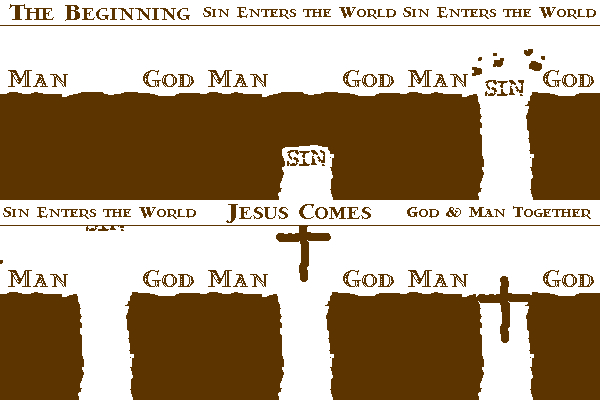
The blood covenant worked this way. The animals were slaughtered and cut up. The pieces were intermingled and then carefully arranged to form a kind of aisle through which the two parties to the covenant would walk together, hands joined.
The principle of a blood covenant, and the symbolism of the rended animal parts was clearly understood to Abram. Whoever broke the covenant would end up like those piles of animals.
A blood covenant was, by common custom, a joining of 2 or more persons, families, clans, tribes, or nations, where the participants agree to do or refrain from doing certain acts. More specifically, God had proposed a patriarchal covenant.
The patriarchal form of covenant is a self-imposed obligation of a superior party, to the benefit of an inferior party. In this form, the terms the parties use to refer to each other are: father and son.
God's proposal included not only Abram, but extended to Abram's seed forever.
(Galatians 3:29 makes plain that Christians are also "Abraham's seed, and heirs according to the promise.")
Are you still with me? Here's where we are so far. Abram has just prepared a blood covenant between himself and God in which his seed would forever be bound to God as heirs. To be an heir, under the implied terms of the covenant, also required being faithful to the Father.
Abram understood those terms and waited for God to appear. Consider the picture. Abram waited, driving away the carrion eaters from his grisly creation, waiting for God Himself to come down, join hands with Abram and together, they would swear a blood oath. God would be the Father of Abram and his descendents, who would then be required behave as sons to keep that covenant.
Genesis 15:12 records that as Abram waited for God, a deep sleep fell upon him. During that deep sleep, "it came to pass, that, when the sun went down, and it was dark, behold a smoking furnace, and a burning lamp that passed between those pieces. In the same day the LORD made a covenant with Abram, saying, Unto thy seed have I given this land, from the river of Egypt unto the great river, the river Euphrates:" (Genesis 15:17-18)
And there's the key! While the covenant was between Abram and God, by passing through the aisle alone, God signed the contract -- alone -- for both sides, binding Himself to keeping both parts.
We know that Abram's seed did NOT remain faithful to the covenant. And violating the blood covenant demanded that somebody had to die. That was what justice required.
The Apostle Paul was, before his conversion on the road to Damascus, a Pharisee, or a religous lawyer, one well qualified to explain the law of covenant oaths.
As Paul explains, "Know ye therefore that they which are of faith, the same are the children of Abraham. (Galatians 3:9) Further. that “they which be of faith are blessed with faithful Abraham." (3:9)
And also, "But that no man is justified by the law in the sight of God, it is evident: for, The just shall live by faith." (3:11)
Of the covenant that God signed on behalf of Abraham, Paul explains "Though it be but a man's covenant, yet if it be confirmed, no man disannulleth, or addeth thereto." (3:15)
The covenant could only be confirmed when the price demanded for its violation was paid in full.
When the Law was given to Moses four centuries later, it was assumed by the Jews that to break it was to break the Abrahamic Covenant, for which the penalty was death. Remember, somebody had to die. But God signed on behalf of Abraham, and Paul pointed out the blood penalty required of the covenant was paid in full.
"And this I say, that the covenant, that was confirmed before of God in Christ, the law, which was four hundred and thirty years after, cannot disannul, that it should make the promise of none effect."
Why did Jesus have to die? Because the covenant demanded satisfactory payment for its violation, and no one who had broken that covenant was qualified to stand in payment except those who signed it.
And God signed on behalf of Abram and his seed.
It is for that reason that God stepped out of eternity and into space and time. To keep the provisions of the original covenant and be a true Son, as it demanded.
And having kept its terms on behalf of sinful humanity, it was incumbent upon Him to make payment, as justice demanded, for its violation by those on whose behalf the covenant was signed.
To be torn and rended like the animals that formed the corridor through which God alone passed.
"But he was wounded for our transgressions, he was bruised for our iniquities: the chastisement of our peace was upon him; and with his stripes we are healed." Isaiah (53:3)
To make restitution on behalf of the seed of Abraham. You. Me. And everyone who ever broke its provision of faithfulness. All of us.
Jesus made that payment on our behalf. On the Cross, as He gave up the ghost, Jesus cried with a loud voice 'it is finished' (Tetelestai!) meaning, "paid in full."
The terms of the violated Covenant were met, its price was paid by its Signer. God's justice was fulfilled. That is why Jesus took on a human form and allowed Himself to be crucified by His own creation. That is the reason the Blood of Christ is so precious. Why nothing less would do.
Because justice demanded it.
And because justice was satisfied, a lost sinner need only accept the Pardon obtained at the Cross as full payment for his sins to obtain eternal life. Because of Good Friday, "Whosoever shall call upon the Name of the Lord SHALL be saved." (Romans 10:13)
Our sin debt was paid in full on Good Friday. The only thing now separating God from man is human pride. Accepting by faith the pardon obtained for us at the Cross is a humbling experience.
We've noted in the past that God's way is not our way, and His thoughts are not our thoughts. Indeed, God's way is usually the exact opposite of human thinking. Christians obtain victory by surrendering. We obtain eternal life through the Death of Christ, but to achieve eternal life one has to first die.
"Good" Friday is the day that commemorates the greatest evil ever perpetrated in the history of mankind. But as it turned out, it was the worst day possible for the forces of evil. It marked the first introduction of pure good to this old world since the Fall of Man.
"He was wounded for our transgressions, He was bruised for our iniquities: the chastisement of our peace was upon Him; and with His stripes WE ARE HEALED." (Isaiah 53:5)
"For God so loved the world, that he gave his only begotten Son, that whosoever believeth in him should not perish, but have everlasting life." (John 3:16)
MARANATHA!
========================================================
And, just like every Good Friday, after evening services, we will come home and watch The Passion of the Christ, as has been our tradition ever since it came out. It is a serious movie that causes us to really take note of the suffering Jesus went through on the Cross for us. We remember the sacrifice, crucifixion and resurrection of Jesus every day, but watching this incredible rendition of it really continues to drive it home and takes the meaning of Easter season even deeper. So from the Boedeker household to yours...blessings to you on this GOOD Friday... ><>