Wise Words

"Wait on the Lord, be strong and of good courage, and He shall strengthen your heart...wait on the Lord. Psalms 27:14

Translation/Search


CLICK FLAGS FOR PAGE TRANSLATION OPTIONS
Google
WWW As My World Turns
Showing posts with label Cross. Show all posts

Sunday, March 31, 2013

Final Thoughts on Resurrection Day 2013

On these final thoughts for Resurrection Day, I want to share my favorite rendition of this song from the original Ernie Haase and Signature Sound group! I hope you enjoy it as much as I do!


This week Christians everywhere acknowledge a pivotal point in history that literally affects EVERYONE! That event is the Resurrection of Jesus Christ.

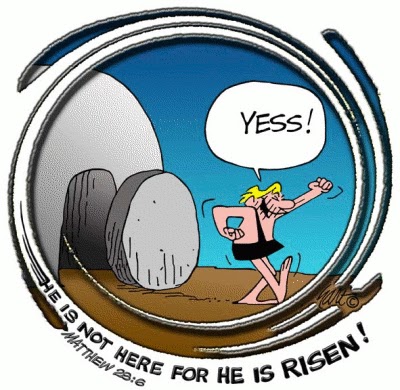
"He is not here, but He is risen" (verse 6) are words that matter eternally. If they are a lie, humanity has no hope after this life. If they are the truth, rejecting the Risen Lord Jesus Christ has eternal consequences. "He who has the Son has the life; he who does not have the Son of God does not have the life" (I John 5:12).

Paul said (I Corinthians 15:14) "and if Christ has not been raised, then our preaching is vain, your faith also is vain."

Many things we believe and do daily matter little. But the Resurrection is eternally important.

The bodily resurrection of Jesus Christ from the dead is the crowning proof of Christianity. Everything else that was said or done by Christ and the Apostles, no matter how great or marvelous, is secondary to the Resurrection in importance. If the Resurrection did not take place, then Christianity is a false religion. If it did take place, then Christ is God and the Christian faith is absolute truth.

Death is man’s greatest enemy, and it has conquered all men but Christ. No matter how brilliant or rich or strong he may be, no man is wise enough to outwit death or wealthy enough to purchase freedom from death or strong enough to vanquish death. The grave always wins the victory, and man sooner or later returns to the dust.

In fact, the inexorable triumph of death applies not only to man, but to all things. Animals die and plants die, and even whole species atrophy and become extinct. Cities and nations, like people, are born and grow for a season, and then fade away. Homes and automobiles and clothes wear out and must eventually go back to the dust, just as do their owners. Even the universe itself is running down and heading toward an ultimate “heat death.”

This universal reign of decay and death is called in the Bible the “bondage to decay” (Romans 8:21). In science it has come to be recognized as the Second Law of Thermodynamics. Also known as the Law of Increasing Entropy, this Second Law is now recognized as a universal law in science, with no known exception ever observed. It says, quite simply, that every system tends to become disordered, to run down and eventually die. Its entropy, which is a measure of disorder, always tends to increase.

The universality of the reign of decay and death is the measure of the absolute uniqueness of the resurrection of Christ. All other men, even the greatest men and the holiest men, have died. Buddha, Mohammed, Zoroaster, Confucius, Caesar, Marx—men who made a profound impact on the world in one way or another—are all dead.

But Jesus Christ is alive!

It is true that He died and was buried, in common with all other men, but unlike other men He returned from Hades, resurrected His own dead body, made it henceforth immortal, and emerged from the tomb, alive forevermore! This was the greatest of all miracles, and could have been accomplished only if Jesus indeed is God, as He had claimed to be.

If all this is somehow a delusion and if Jesus of Nazareth did not really rise from the dead, then He is no different from other great men who are also dead. He is worse than they, in fact, because He is thereby branded as either a charlatan or a madman, since He staked all His claims to absolute deity on His promise to return from the dead.

On the other hand, if the Resurrection is really a demonstrable fact of history, then not only are His claims vindicated, but so are His promises. Death is not, after all, the great victor but is a defeated foe. He has “caused us to be born again to a living hope through the resurrection of Jesus Christ from the dead” (1 Peter 1:3). “But in fact Christ has been raised from the dead, … so also in Christ shall all be made alive” (1 Corinthians 15:20, 22), as the “firstborn of the dead . . . and behold, I am alive forevermore” (Revelation 1:5, 18).*

Dead in our sins, we have only one hope for new life: by trusting in Jesus Christ and relying on His death and resurrection for our salvation. No other spiritual leader has ever conquered death; Jesus is the unique Son of God. He is “the way, and the truth, and the life” (John 14:6), and “whoever believes in [Him], though he die, yet shall he live” (John 11:25).

What difference does the Resurrection make in your life today?


Happy Resurrection Day!

Saturday, March 30, 2013

So, what happened on Saturday?


There is so much talk of Good Friday and Resurrection (Easter) Sunday, but very few people actually talk about Saturday and what happened in between the two. I wonder why that is? Saturday is the pivot point. The day before the single greatest event in history. The day before death and hell were conquered! It’s the day of uncertainty and worry and sorrow.

Put yourself in the Apostle’s shoes for a moment.

You have just seen all your hopes and dreams shattered by the Roman executioners. Not only that, but you aren't that proud of yourself, either. For three years, you followed the Master. You personally witnessed His miracles, from walking on water to feeding multiplied thousands with a young boy's lunch to healing the sick and raising the dead.

You heard His wisdom; you felt His Power, witnessed His Transfiguration . . . and when the chips were down and it was time to take a stand, you folded up like a Wal Mart lawn chair.

You ran and hid like a coward, not daring to show your face for fear you'd share His fate.

(And you once had the nerve to ask Him if you could sit at His right Hand!)

He faced His enemies alone, without a friend to speak up for Him -- including you, who promised NEVER to forsake Him.

On Good Friday, 1980 years ago, the last thing on any of their minds was writing a detailed record of their own failures. They just wanted to put the entire sordid experience behind them and move on.

He had forsaken everything to teach and prepare them, and when the time came, they not only betrayed Him by deserting Him, they never had a chance to beg His forgiveness afterwards.

How would you be feeling at this point if you were them? Ashamed? Afraid? Numb with grief? Confused? Here you expected Jesus to rule over all as King. Instead He has been tortured in a way that the Bible says no man has ever suffered more and then was crucified and now lay in a sealed and guarded tomb. Your hope is gone. What do you have to look forward to now?

And what about Mary, the mother of Jesus? Being the mother of a precious little boy, myself, I can’t imagine what she went through. Seeing Jesus beaten, tortured, ridiculed, spat upon and crucified like a common criminal – knowing He was innocent. Did she replay in her mind as Jesus stumbled under the weight of the cross, the other times He stumbled in His childhood…and, yet, knowing that this time she was unable to pick Him up and hold Him in her arms, kiss the boo-boo and assure Him that everything was going to be ok?

Being a mother, that, to me, is the most difficult position to try and put myself in. I can’t. Honestly, I don’t want to. It hurts my heart too much to even try to imagine being in her place.

BUT…

What we know now, and what the disciples and Mary didn’t know then, was that Sunday was coming…

Just one day away…

And that would be the day when EVERYTHING changed!

AMEN!


Friday, March 29, 2013

WHY Did Jesus Have to Die and What's So "GOOD" About Good Friday?


Before I get into that topic, which is, quite frankly, fascinating . . . In honor of Good Friday I am loading two of my all time favorite songs from Sandi Patty called "The Via Dolorosa" and "The Day He Wore My Crown". I have had Via Dolorosa memorized for going on 25 years now, including the Spanish verse, and I sing it year round. There is no other voice that tells either of these stories so well as Sandi's voice.


Isaiah 53
1 Who has believed our message
and to whom has the arm of the LORD been revealed?
2 He grew up before Him like a tender shoot,
and like a root out of dry ground.
He had no beauty or majesty to attract us to him,
nothing in His appearance that we should desire Him.
3 He was despised and rejected by men,
a man of sorrows, and familiar with suffering.
Like one from whom men hide their faces
He was despised, and we esteemed him not.
4 Surely He has borne our griefs
and carried our sorrows,
yet we considered him stricken by God,
smitten by Him, and afflicted.
5 But He was pierced for our transgressions,
He was bruised for our iniquities;
the punishment that brought us peace was upon Him,
and by His stripes we are healed.
6 We all, like sheep, have gone astray,
each of us has turned to his own way;
and the LORD has laid on Him
the iniquity of us all.
7 He was oppressed and afflicted,
yet He did not open His mouth;
He was led like a lamb to the slaughter,
and as a sheep before its shearers is silent,
so He did not open His mouth.
8 He was taken from prison and from judgment,
And who will declare His generation?
For He was cut off from the land of the living;
For the transgressions of My people He was stricken.
9 He was assigned a grave with the wicked,
and with the rich in His death,
though He had done no violence,
nor was any deceit in His mouth.
10 Yet it was the LORD's will to crush him and cause him to suffer,
and though the LORD makes His soul an offering for sin,
He will see his offspring and prolong his days,
and the will of the LORD will prosper in His hand.
11 After the suffering of His soul,
He will see the light of life and be satisfied;
by His knowledge my righteous servant will justify many,
and He will bear their iniquities.
12 Therefore I will give Him a portion among the great,
and He will divide the spoils with the strong,
because He poured out his life unto death,
and was numbered with the transgressors.
For he bore the sin of many,
and made intercession for the transgressors.

Isaiah 53 was written many centuries before Jesus was born, and yet, it tells of His death on the cross for our sins. And He willingly did it, so great was His love for us. So desirous of us to have eternal life with Him that He shed His blood, took the sins of the entire world, past, present and future, of ALL mankind, for all the sinners, us as well as the murderers, the liars, the cheaters, the adulterers, the thieves, and on and on. While we may view sin on a "sliding scale", God doesn't. We ALL are sinners. The only person who was ever perfect and able to be that sacrifice on our behalf was the Son of God, who left His realm of glory in heaven and humbled himself to become like us, as a son of man, in order to fulfill the Covenant that God made with Abraham so many years ago.

In this post will explain the Abrahamic Covenant and what it means for us and why Jesus was the fulfillment of that Covenant, who He was and, most importantly, why He had to die.

This information comes from my friend Jack Kinsella and the Omega Letter. (His powerful explanation is just one reason why he is missed so much)

Why Did Jesus Have To Die and What's so "GOOD" About Good Friday?

Yesterday as we were coming home from church, my grandson Bailey chirped, "Gwandad!! Jesus died for you!" There was a pause and he said, "He died on a Cross because bad men put him there. He was covered with boo-boos!" (Being three, Bailey is not up on all the latest medical terms, but he knew what he was talking about) "An' He died for Mummy and for Gwandma and because He loves us."

I was absorbing all this as I drove when Bailey asked me the next logical question. "Gwanddad!" "Yes, Bailey." "Why did He have to die?"

When we got home, I tried to explain to a three-year old something that many adult Christians have difficulty explaining. Yet it is one of the first questions posed by the skeptic.

Why, indeed, if Jesus was God, did He have to die? To the skeptic, the whole Cross, Blood and death thing doesn't make any sense. I know many Christians to whom the answer is simply, "So He could be resurrected on the third day."

That was never a satisfactory answer when I was a skeptic, either.

According to Christian tradition, the Friday before Easter is called "Good Friday" because it is the day that Jesus Christ was crucified. GOOD Friday?

The Crucifixion most probably did not actually take place on a Friday, anyway. The Scriptures make reference only to the 'Sabbath' and there were two Sabbath days during that particular Passover week.

But it is on Friday that the world remembers, whether it wants to or not, that a Man was crucified on a hill called Golgotha outside the walls of Jerusalem for the sins of mankind.

If the world wants to remember it as a Friday, at least it is taking note of the event. Arguing about whether or not it actually took place on Wednesday or Thursday seems irrelevant to the central point.

Particularly in light of the way it remembers that day, as "Good" Friday. But what is so good about it?

I can recall as a kid growing up in a Catholic school thinking it more than a little strange that all those nuns said they loved Jesus, but celebrated the day of His execution as a "Good" day.

Indeed, as a kid, I thought the designation "Good Friday" was evidence that they really didn't LIKE Him very much, despite their protestations of love. My mother had passed away when I was only ten. I didn't think that the day that she died was a 'good' day for me.

There are lots of possible reasons why the day of Jesus' Crucifixion is designated "Good" in English. One is that the word 'good' was derived from the word "God".

Our word 'goodbye' came from the phrase "God be with you," so, according to that line of thinking, "Good Friday" would have originated from the phrase "God's Friday."

But I think it is less a case of the metamorphosis of language than it is an apt description of the Event that took place on that day just before the Passover two thousand years ago.

The execution of Jesus Christ was an event of incredible evil. He was guilty of no infraction, violated no laws, either Mosaic or Roman civil, and His betrayal was orchestrated, the Bible says, by Satan himself.

"And after the sop Satan entered into him [Judas]. Then said Jesus unto him, That thou doest, do quickly." (John 13:27)

But while the crucifixion of Jesus Christ was an act of unspeakable evil, it was a necessary part of God's Plan for the redemption of our sin debt.

And the manner in which He accomplished was a demonstration of His Power over good and evil, using pure evil to bring about pure good.

"Which none of the princes of this world knew: for had they known it, they would not have crucified the Lord of glory." (1st Corinthians 2:8)

But why was Good Friday necessary? We've gone over this before, but not in several years. Good Friday is the perfect day to revisit the topic. Why did Jesus have to die?

The Scripture says God's Justice demands a sacrifice, but for most Christians contending with the skeptic, that answer is unsatisfactory.

The explanation that only a sinless man was qualified to take on the sins of the world makes sense, but it doesn't answer the nuts-and-bolts question of why He had to die. Not fully.

The answer to the nuts-and-bolts legalities is found, not in the New Testament, but rather in the Old.  I thought it might be good if we were ALL equipped to give a reason for the hope that is in us.

In Genesis Chapter 15, we find Abram questioning God's promise that his seed will be numbered as the stars of heaven and that they would inherit the land to which God had led him.

Genesis 15:6 says "And he believed in the LORD; and he counted it to him for righteousness." But Abram wanted a guarantee, nonetheless.

"And he [Abram] said, LORD God, whereby shall I know that I shall inherit it?" (15:8)

It was then that God proposed a blood covenant after the manner of the Chaldeans. "And he [God] said unto him, [Abram] Take me an heifer of three years old, and a she goat of three years old, and a ram of three years old, and a turtledove, and a young pigeon."

Abram knew what to do next, since this was something he was familiar with. "And he took unto him all these, and divided them in the midst, and laid each piece one against another: but the birds divided he not."

The blood covenant worked this way. The animals were slaughtered and cut up. The pieces were intermingled and then carefully arranged to form a kind of aisle through which the two parties to the covenant would walk together, hands joined.

The principle of a blood covenant, and the symbolism of the rended animal parts was clearly understood to Abram. Whoever broke the covenant would end up like those piles of animals.

A blood covenant was, by common custom, a joining of 2 or more persons, families, clans, tribes, or nations, where the participants agree to do or refrain from doing certain acts. More specifically, God had proposed a patriarchal covenant.

The patriarchal form of covenant is a self-imposed obligation of a superior party, to the benefit of an inferior party. In this form, the terms the parties use to refer to each other are: father and son.

God's proposal included not only Abram, but extended to Abram's seed forever.

(Galatians 3:29 makes plain that Christians are also "Abraham's seed, and heirs according to the promise.")

Are you still with me? Here's where we are so far. Abram has just prepared a blood covenant between himself and God in which his seed would forever be bound to God as heirs. To be an heir, under the implied terms of the covenant, also required being faithful to the Father.

Abram understood those terms and waited for God to appear. Consider the picture. Abram waited, driving away the carrion eaters from his grisly creation, waiting for God Himself to come down, join hands with Abram and together, they would swear a blood oath. God would be the Father of Abram and his descendents, who would then be required behave as sons to keep that covenant.

Genesis 15:12 records that as Abram waited for God, a deep sleep fell upon him. During that deep sleep, "it came to pass, that, when the sun went down, and it was dark, behold a smoking furnace, and a burning lamp that passed between those pieces. In the same day the LORD made a covenant with Abram, saying, Unto thy seed have I given this land, from the river of Egypt unto the great river, the river Euphrates:" (Genesis 15:17-18)

And there's the key! While the covenant was between Abram and God, by passing through the aisle alone, God signed the contract -- alone -- for both sides, binding Himself to keeping both parts.

We know that Abram's seed did NOT remain faithful to the covenant. And violating the blood covenant demanded that somebody had to die. That was what justice required.

The Apostle Paul was, before his conversion on the road to Damascus, a Pharisee, or a religous lawyer, one well qualified to explain the law of covenant oaths.

As Paul explains, "Know ye therefore that they which are of faith, the same are the children of Abraham. (Galatians 3:9) Further. that “they which be of faith are blessed with faithful Abraham." (3:9)

And also, "But that no man is justified by the law in the sight of God, it is evident: for, The just shall live by faith." (3:11)

Of the covenant that God signed on behalf of Abraham, Paul explains "Though it be but a man's covenant, yet if it be confirmed, no man disannulleth, or addeth thereto." (3:15)

The covenant could only be confirmed when the price demanded for its violation was paid in full.

When the Law was given to Moses four centuries later, it was assumed by the Jews that to break it was to break the Abrahamic Covenant, for which the penalty was death. Remember, somebody had to die. But God signed on behalf of Abraham, and Paul pointed out the blood penalty required of the covenant was paid in full.

"And this I say, that the covenant, that was confirmed before of God in Christ, the law, which was four hundred and thirty years after, cannot disannul, that it should make the promise of none effect."

Why did Jesus have to die? Because the covenant demanded satisfactory payment for its violation, and no one who had broken that covenant was qualified to stand in payment except those who signed it.

And God signed on behalf of Abram and his seed.

It is for that reason that God stepped out of eternity and into space and time. To keep the provisions of the original covenant and be a true Son, as it demanded.

And having kept its terms on behalf of sinful humanity, it was incumbent upon Him to make payment, as justice demanded, for its violation by those on whose behalf the covenant was signed.

To be torn and rended like the animals that formed the corridor through which God alone passed.

"But he was wounded for our transgressions, he was bruised for our iniquities: the chastisement of our peace was upon him; and with his stripes we are healed." Isaiah (53:3)

To make restitution on behalf of the seed of Abraham. You. Me. And everyone who ever broke its provision of faithfulness. All of us.

Jesus made that payment on our behalf. On the Cross, as He gave up the ghost, Jesus cried with a loud voice 'it is finished' (Tetelestai!) meaning, "paid in full."

The terms of the violated Covenant were met, its price was paid by its Signer. God's justice was fulfilled. That is why Jesus took on a human form and allowed Himself to be crucified by His own creation. That is the reason the Blood of Christ is so precious. Why nothing less would do.

Because justice demanded it.

And because justice was satisfied, a lost sinner need only accept the Pardon obtained at the Cross as full payment for his sins to obtain eternal life. Because of Good Friday, "Whosoever shall call upon the Name of the Lord SHALL be saved." (Romans 10:13)

Our sin debt was paid in full on Good Friday. The only thing now separating God from man is human pride. Accepting by faith the pardon obtained for us at the Cross is a humbling experience.

We've noted in the past that God's way is not our way, and His thoughts are not our thoughts. Indeed, God's way is usually the exact opposite of human thinking. Christians obtain victory by surrendering. We obtain eternal life through the Death of Christ, but to achieve eternal life one has to first die.

"Good" Friday is the day that commemorates the greatest evil ever perpetrated in the history of mankind. But as it turned out, it was the worst day possible for the forces of evil. It marked the first introduction of pure good to this old world since the Fall of Man.

"He was wounded for our transgressions, He was bruised for our iniquities: the chastisement of our peace was upon Him; and with His stripes WE ARE HEALED." (Isaiah 53:5)

"For God so loved the world, that he gave his only begotten Son, that whosoever believeth in him should not perish, but have everlasting life." (John 3:16)

MARANATHA!
========================================================
And, just like every Good Friday, after evening services, we will come home and watch The Passion of the Christ, as has been our tradition ever since it came out. It is a serious movie that causes us to really take note of the suffering Jesus went through on the Cross for us. We remember the sacrifice, crucifixion and resurrection of Jesus every day, but watching this incredible rendition of it really continues to drive it home and takes the meaning of Easter season even deeper. So from the Boedeker household to yours...blessings to you on this GOOD Friday... ><>

Thursday, March 28, 2013

WHO is Jesus anyway?


In honor of Holy Week, and with tonight being the commonly accepted night of The Last Supper, I think it appropriate to discuss the topic of just WHO Jesus IS. Not "was", because He lives! He is alive today. So, for the scholarly mind, today we will delve into just WHO He is. Bear with me as there is a lot of information contained here, but there has to be in order to understand the awesomeness of Jesus and God's plan for mankind!

Most people believe that Jesus existed but there are differing answers as to just who they think He was. Most people say that He was just a good man, a teacher or a prophet, instead of actually being the Son of God. Some dismiss him as a liar or even a madman. Millions hail him as Savior and Lord. Whatever people think of him, nobody can deny that he stands at the very crux of human history. There is no doubt that He is the most influential person who ever lived. In this post we are going to explore the probability that Jesus was who He said He was.

The Biblical record of his life shows that Jesus was born to a virgin, lived a sinless life, taught throughout the Palestinian region for about three years, was crucified and then rose back to life three days after his death. The Bible claims that more than 500 people saw him alive after this miraculous event. How could a mere man have lived such a life? The miracles Jesus performed, his death on the cross, his resurrection, his ascent to heaven--all point to the fact that he was no ordinary leader.

Hundreds of years before Jesus' birth, prophets predicted his coming. The Old Testament, written by many people over a period of 1,500 years, contains more than 300 such prophecies, 456 to be exact. All of these details came true, including his miraculous birth, his sinless life, his many miracles, his death and his resurrection.

The reason why prophecy is an indication of the divine authorship of the Scriptures, and hence a testimony to the trustworthiness of the Message of the Scriptures, is because of the minute probability of fulfillment.

Anyone can make predictions. Having those prophecies fulfilled is vastly different. In fact, the more statements made about the future, and the more the detail, then the less likely the precise fulfillment will be.

For example, what's the likelihood of a person predicting today the exact city in which the birth of a future leader would take place, well into the 21st century? This is indeed what the prophet Micah did 700 years before the Messiah. Further, what is the likelihood of predicting the precise manner of death that a new, unknown religious leader would experience, a thousand years from now - a manner of death presently unknown, and to remain unknown for hundreds of years? Yet, this is what David did in 1000 B.C.

Again, what is the likelihood of predicting the specific date of the appearance of some great future leader, hundreds of years in advance? This is what Daniel did, 530 years before Christ.

If one were to conceive 50 specific prophecies about a person in the future, whom one would never meet, just what's the likelihood that this person will fulfill all 50 of the predictions? How much less would this likelihood be if 25 of these predictions were about what other people would do to him, and were completely beyond his control?

For example, how does someone "arrange" to be born in a specific family?

How does one "arrange" to be born in a specified city, in which their parents don't actually live? How does one "arrange" their own death - and specifically by crucifixion, with two others, and then "arrange" to have their executioners gamble for His clothing (John 16:19; Psalms 22:18)? How does one "arrange" to be betrayed in advance? How does one "arrange" to have the executioners carry out the regular practice of breaking the legs of the two victims on either side, but not their own? Finally, how does one "arrange" to be God? How does one escape from a grave and appear to people after having been killed?

Indeed, it may be possible for someone to fake one or two of the Messianic prophecies, but it would be impossible for any one person to arrange and fulfill all of these prophecies.

John Ankerberg relates the true story of how governments use prearranged identification signs to identify correct agents:

David Greenglass was a World War II traitor. He gave atomic secrets to the Russians and then fled to Mexico after the war. His conspirators arranged to help him by planning a meeting with the secretary of the Russian ambassador in Mexico City. Proper identification for both parties became vital. Greenglass was to identify himself with six prearranged signs. These instructions had been given to both the secretary and Greenglass so there would be no possibility of making a mistake. They were: (1) once in Mexico City, Greenglass was to write a note to the secretary, signing his name as "I. JACKSON"; (2) after three days he was to go to the Plaza de Colon in Mexico City and (3) stand before the statue of Columbus, (4) with his middle finger placed in a guide book. In addition, (5) when he was approached, he was to say it was a magnificent statue and that he was from Oklahoma. (6) The secretary was to then give him a passport.

These six prearranged signs worked. Why? With six identifying characteristics it was impossible for the secretary not to identify Greenglass as the proper contact (John Ankerberg, John Weldon and Walter Kaiser, "The Case for Jesus The Messiah", Melbourne: Pacific College Study Series, 1994, 17-18).

How true, then, it must be that Jesus of Nazareth is the Messiah, if he had 456 identifying characteristics well in advance, and fulfilled them all! In fact, what does the science of probability make of this?

The science of probability attempts to determine the chance that a given event will occur. The value and accuracy of the science of probability has been well established beyond doubt - for example, insurance rates are fixed according to statistical probabilities.

Professor Emeritus of Science at Westmont College, Peter Stoner, has calculated the probability of one man fulfilling the major prophecies made concerning the Messiah. The estimates were worked out by twelve different classes representing some 600 university students.

The students carefully weighed all the factors, discussed each prophecy at length, and examined the various circumstances which might indicate that men had conspired together to fulfill a particular prophecy. They made their estimates conservative enough so that there was finally unanimous agreement even among the most skeptical students.

However Professor Stoner then took their estimates, and made them even more conservative. He also encouraged other skeptics or scientists to make their own estimates to see if his conclusions were more than fair. Finally, he submitted his figures for review to a committee of the American Scientific Affiliation. Upon examination, they verified that his calculations were dependable and accurate in regard to the scientific material presented (Peter Stoner, Science Speaks, Chicago: Moody Press, 1969, 4).

For example, concerning Micah 5:2, where it states the Messiah would be born in Bethlehem Ephrathah, Stoner and his students determined the average population of BETHLEHEM from the time of Micah to the present; then they divided it by the average population of the earth during the same period.

They concluded that the chance of one man being born in Bethlehem was one in 300,000, (or one in 2.8 x 10^5 - rounded),

After examining only eight different prophecies (Idem, 106), they conservatively estimated that the chance of one man fulfilling all eight prophecies was one in 10^17.

To illustrate how large the number 10^17 IS (a figure with 17 zeros), Stoner gave this illustration :

If you mark one of ten tickets, and place all the tickets in a hat, and thoroughly stir them, and then ask a blindfolded man to draw one, his chance of getting the right ticket is one in ten. Suppose that we take 10^17 silver dollars and lay them on the face of Texas. They'll cover all of the state two feet deep. Now mark one of these silver dollars and stir the whole mass thoroughly, all over the state. Blindfold a man and tell him that he can travel as far as he wishes, but he must pick up one silver dollar and say that this is the right one. What chance would he have of getting the right one? Just the same chance that the prophets would've had of writing these eight prophecies and having them all come true in any one man, from their day to the present time, providing they wrote them in their own wisdom (Idem, 106-107).

In financial terms, is there anyone who would not invest in a financial venture if the chance of failure were only one in 10^17? This is the kind of sure investment we're offered by God for faith in His Messiah.

From these figures, Professor Stoner, concludes the fulfillment of these eight prophecies alone proves that God inspired the writing of the prophecies (Idem, 107) - the likelihood of mere chance is only one in 10^17!

Another way of saying this is that any person who minimizes or ignores the significance of the biblical identifying signs concerning the Messiah would be foolish.

But, of course, there are many more than eight prophecies. In another calculation, Stoner used 48 prophecies (Idem, 109) (even though he could have used Edersheim's 456), and arrived at the extremely conservative estimate that the probability of 48 prophecies being fulfilled in one person is the incredible number 10^157. In fact, if anybody can find someone, living or dead, other than Jesus, who can fulfill only half of the predictions concerning the Messiah given in the book "Messiah in Both Testaments" by Fred J. Meldau, the Christian Victory Publishing Company is ready to give a ONE thousand dollar reward! As apologist Josh McDowell says, "There are a lot of men in the universities that could use some extra cash!" (Josh McDowell, Evidence that Demands a Verdict, California: Campus Crusade for Christ, 175).

How large is the number one in 10^157? 10^157 contains 157 zeros! Stoner gives an illustration of this number using electrons. Electrons are very small objects. They're smaller than atoms. It would take 2.5 TIMES 10^15 of them, laid side by side, to make one inch. Even if we counted 250 of these electrons each minute, and counted day and night, it would still take 19 million years just to count a line of electrons one-inch long (Stoner, op. cit, 109).

With this introduction, let's go back to our chance of one in 10^157. Let's suppose that we're taking this number of electrons, marking one, and thoroughly stirring it into the whole mass, then blindfolding a man and letting him try to find the right one. What chance has he of finding the right one? What kind of a pile will this number of electrons make? They make an inconceivably large volume.

This is the result from considering a mere 48 prophecies. Obviously, the probability that 456 prophecies would be fulfilled in one man by chance is vastly smaller. According to Emile Borel, once one goes past one chance in 10^50, the probabilities are so small that it is impossible to think that they will ever occur (Ankerberg et. al., op. cit., 21).

As Stoner concludes, 'Any man who rejects Christ as the Son of God is rejecting a fact, proved perhaps more absolutely than any other fact in the world (Stoner, op. cit., 112).'

God so thoroughly vindicated Jesus Christ that even mathematicians and statisticians, who were without faith, had to acknowledge that it is scientifically impossible to deny that Jesus is the Christ.

By his own account, Jesus claimed he had the power to forgive sins, to cast out demons, and to determine people's eternal destiny. He even declared he himself was God!

In his famous book Mere Christianity, C.S. Lewis makes this statement, "A man who was merely a man and said the sort of things Jesus said would not be a great moral teacher. He would either be a lunatic--on the level with a man who says he is a poached egg--or he would be the devil of hell. You must take your choice. Either this was, and is, the Son of God, or else a madman or something worse. You can shut him up for a fool or you can fall at his feet and call him Lord and God. But let us not come with any patronizing nonsense about his being a great human teacher. He has not left that open to us."

Jesus could only have been one of four things: a legend, a liar, a lunatic--or Lord and God. There is so much historical and archeological evidence to support his existence that every reputable historian agrees he was not just a legend. If he were a liar, why would he die for his claim, when he could easily have avoided such a cruel death with a few choice words? And, if he were a lunatic, how did he engage in intelligent debates with his opponents or handle the stress of his betrayal and crucifixion while continuing to show a deep love for his antagonists? He said he was Lord and God. The evidence supports that claim.

As you ponder this coming Good Friday, remember that He died for YOU. His death was our gift. The Gift of Salvation for all who believe and accept it. There are no strings attached. It's a gift freely given to one who will freely receive. Can you imagine anyone else who would give that kind of a gift for you?

John 3:16: For God SO LOVED the world (you, me, your friends and loved ones, your neighbors, strangers in foreign countries and, yes, even your enemies), that He gave His ONLY Son (to be the sacrifice for our sins in order to live in Eternity with Him), that whosoever believes in Him (as the Son of God and accepts Jesus as their Savior) shall not perish but have EVERLASTING LIFE (even though our bodies may die, our souls live on and it is YOUR choice where you end up for Eternity – do you choose Eternal Life or Eternal Death and Torment?).
============================================================================

Thursday: The Last Supper: The Lord Jesus, on the night he was betrayed, took bread, and when He had given thanks, He broke it and said, "This is my body, given for you; do this in remembrance of me." In the same way, after supper He took the cup of wine, saying, "Drink from it, all of you. This is my blood of the covenant, which is poured out for many for the forgiveness of sins; do this, whenever you drink it, in remembrance of me."  

Wednesday, March 27, 2013

The Logic of the Cross


Keeping up with Holy Week, here is an EXCELLENT piece on the LOGIC of the Cross. This is logic that it is really quite hard to argue with. Again, my thanks to my very dear and recently departed friend, Jack Kinsella, for providing this, and the other in-depth pieces on the Cross and Resurrection this week. This is just one of many reasons why I miss my friend, because he had the incredible ability to explain perfectly what he was wanting to convey...on any topic. But I do not grieve for him for he will be celebrating the Resurrection this year with the ONE who was Resurrected! AMEN!

The Logic of the Cross

Roughly one thousand, nine hundred and eighty years ago, a Jewish itinerant preacher was tried, convicted and executed by Roman decree, on charges of sedition against the state.

When He was arrested by the Roman authorities, His friends, fearing arrest themselves, left Him to face the music alone. One of His closest and most loyal friends denied knowing Him on three separate occasions. Once followed by thronging crowds, only His mother and a couple of friends stood by Him to the end.

And thus ends the story of Jesus of Nazareth, just another victim of Roman 'justice' like the thousands of other unnamed and forgotten Jewish rebels that shared a similar fate.

Or, at least, that is where is SHOULD have ended.

Historically speaking, at the time of His Death, Jesus Christ was just another rebel in a land teeming with rebels. When He preached of the Kingdom of Heaven, his followers didn't understand the term the way that we do.

The sages understood the time of the Judges, when Israel was ruled by Heaven through God's appointed judges, as the Kingdom of Heaven He promised to restore.

Even His disciples didn't understand what He was talking about until after they received the Holy Spirit at Pentecost.

"When they therefore were come together, they asked of Him, saying, Lord, wilt Thou at this time restore again the kingdom to Israel?" (Acts 1:6)

They, like the rest, expected an earthly Jewish kingdom ruled by Jews, restored to the glory it had at its peak under King David.

When their dreams of a restored Kingdom of Israel died on a Roman cross, the event was too insignificant to merit the attention of the historians of the time. Only a few, like Tertius or Flavius Josephus mention it, and then, only in passing.

Crucifixion was common enough, but it was a grisly business, difficult to discuss without repulsing the reader. Although Imperial Rome imposed it on hundreds of thousands during its reign, historians recorded few details of the process itself.

By either chance or design, death by crucifixion served to erase the condemned from memory. It wasn't talked about, so neither were its victims.

On Good Friday, 1980 years ago, it looked like Jesus Christ was on the fast track to historical irrelevance, just another voice of one crying out from the wilderness.


A voice seemingly silenced forever -- by a death too gruesome to discuss in polite company.

Assessment:

Now, imagine you are one of His chosen disciples. You have just seen all your hopes and dreams shattered by the Roman executioners. Not only that, but you aren't that proud of yourself, either.

For three years, you followed the Master. You personally witnessed His miracles, from walking on water to feeding multiplied thousands with a young boy's lunch to healing the sick and raising the dead.

You heard His wisdom; you felt His Power, witnessed His Transfiguration . . . and when the chips were down and it was time to take a stand, you folded up like a Wal Mart lawn chair.

You ran and hid like a coward, not daring to show your face for fear you'd share His fate.

(And you once had the nerve to ask Him if you could sit at His right Hand!)

He faced His enemies alone, without a friend to speak up for Him -- including you, who promised NEVER to forsake Him.

On Good Friday, 1980 years ago, the last thing on any of their minds was writing a detailed record of their own failures. They just wanted to put the entire sordid experience behind them and move on.

He had forsaken everything to teach and prepare them, and when the time came, they not only betrayed Him by deserting Him, they never had a chance to beg His forgiveness afterwards.

To those who loved Him best, Good Friday, 1980 years ago, was anything BUT 'good'.

And it was the LAST story in the world they wanted to spread throughout the land.

"He made big promises, we made big promises, then He died and we all ran away and hid."

If you were hiding somewhere in Jerusalem on Good Friday, 1980 years ago, that was your story. Not a very inspiring story, if that was where it ended.

Every Easter, we are bombarded by secular apologists telling us that is where the story really DID end.

Jesus was dead; His followers were all in hiding, but while they were in hiding for their lives (and after seeing what happened to Jesus,) instead of fading quietly into the countryside, they entered into a conspiracy to perpetuate the same 'myth' that put Jesus on the Cross in the first place.

They made up the whole Resurrection story to keep the movement alive, and then legend took over, the argument goes.

If the story really DID end at Golgotha, would YOU want to face the same risk that you had just abandoned your best Friend to His Death in order to avoid? Well, would you?

Would anybody?

IF it ended at Golgotha, then what changed every single one of the cowards who fled Jesus on that day to later face death unflinchingly rather than deny Him a second time?

Moreover, what made these guys, who were so self-centered they used to argue over who would sit at His right Hand in some misty, undefined future kingdom, choose to disclose the details of their greatest moment of personal failure, weaving those unflattering self-revelatory details into the fabric of what they already KNEW a monstrous lie?

Since most of it was a lie anyway, why be so brutally hard on themselves?

The Archbishop of Canterbury is on record as doubting the Resurrection as an actual historical event. This defies logic. If the Resurrection wasn't an historical event, then it ended at Golgotha -- and the Apostles knew it.

Every single event from the Cross forward was a lie, and the New Testament record of their zeal to propagate that lie is equally unreliable. THIS is the argument put forth every Easter by the secularists as the epitome of 'rational thought.'

No logical alternative explanation for why the Apostles chose death over denial of what they KNEW, by definition, was a myth. To plug THAT hole, critics say the story was 'harmonized' later as the Bible was being assembled by the Nicean Council.

But nobody ever goes back to Good Friday, 1980 years ago, where they claim it all ended, to explain with any degree of credibility, why it didn't. Because if Jesus was not raised on the first day of the week, where He subsequently appeared to more than five hundred witnesses (1st Corinthians 15:6) then it SHOULD have.

Christianity SHOULD have died with Jesus, and on Good Friday 1980 years ago, to all intents and purposes, it did.

And it would have STAYED dead, but Christianity was raised with Jesus Christ on the third day, and today, it is real enough to have the secularists jumping through logical hoops every Easter season trying to prove its all a myth.

For those who demand empirical evidence of the Resurrection, the existence of the question is all the evidence logic demands.

Had it really ended on Good Friday, 1980 years ago at the Cross, nobody would be asking the question in the first place.

When Jesus appeared to John on the Island of Patmos, He identified himself as the Alpha and the Omega, the beginning AND the end.

The logic of Christianity is that it began where it ended -- without the Cross, there could be no Resurrection. And without the Resurrection, there is no reason to remember the Cross.

To the secularist, this is an unacceptable conundrum, despite the fact his best alternative explanation leaves him with no reason for Christianity to exist for him to question.

It is a logical circle from which he can't escape, because he can't see he's inside the circle.

"But the natural man receiveth not the things of the Spirit of God: for they are foolishness unto him: neither can he know them, because they are spiritually discerned." (1st Corinthians 2:14)

As foolish as his argument is, he can't see it for the foolishness of his own wisdom.

"For the wisdom of this world is foolishness with God. For it is written, He taketh the wise in their own craftiness." (1st Corinthians 3:19)

So every year, the annual bombardment of articles questioning the 'truth' of the Resurrection continues without their ever seeing the answer is contained inside the very question they are so focused on.

It is as baffling to the natural mind as is the reason we Christians call this upcoming Friday, "Good Friday".

"For the preaching of the cross is to them that perish foolishness; but unto us which are saved it is the power of God." (1st Corinthians 1:18)

Tuesday, March 19, 2013

Thank God REDEEMED

So, today...2 times each I have heard the following songs: Redeemed by Big Daddy Weave and East To West by Casting Crowns. I mean, really...what are the odds of that happening, 2 separate times I was in the truck between 30 minutes to 1 hour each time other than it’s a God thing? So here’s what I’ve been thinking about as a result, what has been brought to my mind...

Each of these songs reference the gift that was given to us at the Cross through the entirely selfless act of Jesus voluntarily taking on the sins of the entire world... Past, Present, Future – EVERYONE...mine, yours, the bully from 6th grade, the neighbor that purposely antagonizes you, the murder on death row, etc. He didn’t come to die for just specific people, He willingly gave up His life for all of us.

These two songs speak to me so much because I know what I’ve done and who I’ve been in the past. Who I’ve loved, lusted after, stolen from, talked about, hated and on and on. God says in the Bible that if you look at someone with lust in your heart, you have committed adultery with them. If you have hated someone, it is the same as having murdered them. As the man thinketh in his heart, so he is. (Prov 23:7) That is why it is so important to guard your thoughts and your heart and especially your mouth. (separate post coming on that one).

And there are days when I feel like I’m taking 3 steps back and zero steps forward and immediately I regret, I feel bad...I feel guilty. But you know what? Guilt and regret are NOT from God. God in His infinite Mercy and Grace doesn’t just forgive...He forgets. He erases the board. He deletes the file. He destroys the evidence. He doesn’t remember our mistakes. For all the things he does do, this is one thing he refuses to do. He refuses to keep a list of our wrongs. He just plain doesn’t remember.

But we do. You still remember what you did before you changed. Sins you’ve confessed; errors of which you’ve repented; damage you’ve done your best to repair. And though you’re no longer the same person, the ghosts still linger. They get in your face, whisper in your mind and rob you of your joy and remind you of moments when you forgot Whose child you were. They tickle your mind and say things like, “Are you really forgiven? Sure, God forgets most of our mistakes, but do you think He could actually forget the time you... (insert any instance that brings guilt/regret to your mind)” As a result, your spiritual walk has a slight limp. And when you begin to make headway in your spiritual walk, that specter of the past appears and causes you to start doubting yourself.

Be honest now, do you think God is the voice that reminds you of the dirt of your past? Do you think He was joking when He said, “I will remember your sins no more?” Was he exaggerating when He said He would cast our sins as far as the East is from the West? Do you actually believe He would make a statement like “I will not hold their iniquities against them” and then throw them in our faces whenever we ask for help?

Of course not! To love conditionally is against God’s nature. It’s against God’s nature to remember FORGIVEN sins. God is either the God of perfect grace... or he is not God. Grace forgets. He who is perfect love cannot hold grudges. If he does, then he isn’t perfect love. And if he isn’t perfect love, we are chasing rainbows. But I believe in his loving forgetfulness. And I believe he has a graciously terrible memory.

But with that grace, we need to show thankfulness for it. Grace does not mean we have a license to commit the same sin over and over. God has forgiven us. Given us His grace. We need to act like that means something. Because it does. It means that the innocent death of Jesus on the Cross paid the price for our sins.

God has promised us that if we ask forgiveness from our sins with a truly repentant heart He throws them as far as the East is from the West and remembers them no more. Period. End of sentence. Look it up. Psalms 103:12, Isaiah 43:25, Hebrews 8:12. How does He do this without having to have a high priest to intercede on our behalf, as it was in the Old Testament times?

Through the crucifixion, death and resurrection of Jesus who is the ONLY High Priest and intercessor that we require to come to the Throne Room of God.

There is another new song that I heard today that is called “Hello, My Name Is...” by Matthew West and it is what all of us who are in Christ should say when faced with fear, defeat, regret, guilt, etc. over our sins.

“Hello, my name is child of the one true King
I’ve been saved, I’ve been changed, and I have been set free
“Amazing Grace” is the song I sing
Hello, my name is child of the one true King
I am no longer defined
By all the wreckage behind
The One who makes all things new Has proven it’s true”

So coming up on this Easter season, those of us who have found ourselves in Christ, who call Jesus our Savior, we can say “Hello, my name is child of the one true King. I’ve been saved, I’ve been changed, and I have been set free. I am, thank God, REDEEMED by the One who has thrown my sins as far as the East is from the West...through the span of one scarred hand to the other.”